You’d have to be living under a rock, to not see that the defense industry is exploding. Looking at companies like Anduril, and other companies, this is absolutely the era of the defense startup. And it’s been creating this interesting intersection between new technologies and the interoperability of these solutions.
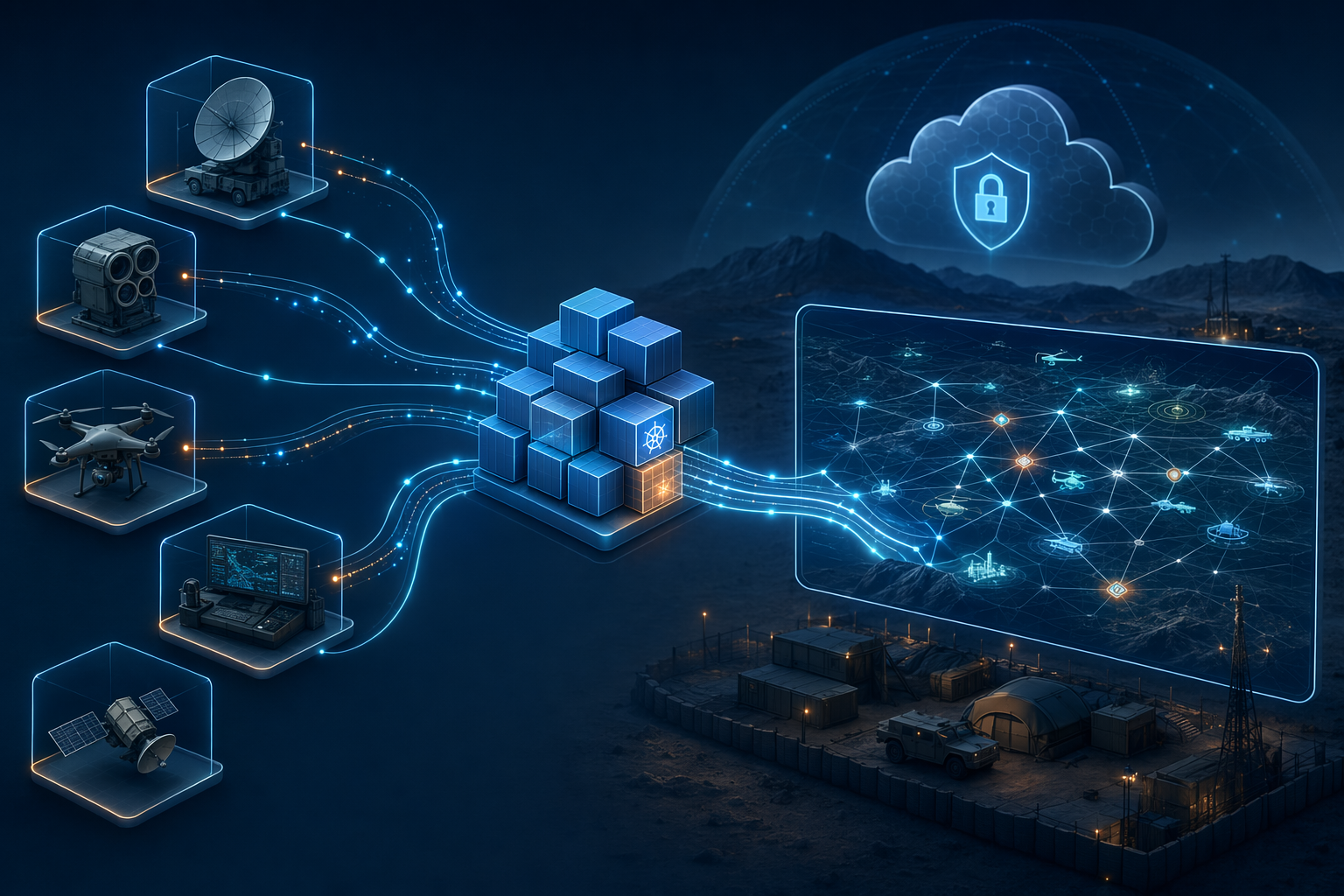
For years, the hardest problem in the field hasn’t been a lack of technology — it’s been too much of it, none of it talking to each other. Soldiers ended up as the human “integration point,” stitching together eight or nine screens by hand while cold, tired, and under pressure. Operation Jailbreak — the Army’s Fort Carson sprint that gathered ~600 people and 50+ industry partners to expose the APIs on more than 70 systems — dragged that problem into the open. For anyone in the Defense Industrial Base, this is the signal: the era of the one‑off, bolt‑on integration is ending, and open, interoperable systems are becoming the price of admission.
It’s worth sitting with just how big “many systems” really is. Every sensor, radio, radar, C2 tool, and weapons platform tends to arrive as its own island, each with its own data format and its own idea of how to connect. For decades the fix was custom middleware and post‑fielding integration — expensive, slow, and brittle every time something changed. The Army’s own leaders described the legacy world as a home where every appliance needs a different adapter just to plug in, and the warfighter was that adapter. When your integration strategy depends on a tired human copying data between screens under fire, you don’t have an integration strategy — you have a liability.
Strip away the buzzwords and it means a few concrete things: modular, open architectures (MOSA) with documented APIs so systems connect by design; containerization and Kubernetes (in Azure, that’s AKS and AKS enabled by Azure Arc) so software is portable across cloud, on‑prem, and the tactical edge; and DevSecOps — the development tooling, pipelines, and security gates that let teams ship trusted software fast. Wrap all of that in Azure Government and air‑gapped/disconnected cloud, and you get mission software that can be built, secured, and run wherever the mission is — including places with no connection back to the cloud at all.
This is the part I get most excited about, because it’s where “portable” stops being a slogan. A container packages an app with everything it needs to run, so it behaves the same on a developer’s laptop, in Azure Government, or on a box at the edge. Kubernetes orchestrates those containers at scale, and AKS gives you a managed version of that — while AKS enabled by Azure Arc extends the same management plane out to on‑prem, edge, and air‑gapped sites. The magic isn’t any single feature; it’s that a team writes and tests once and runs the same artifact everywhere, with consistent APIs, GitOps, and tooling from the cloud all the way to bare metal.
Portability without security is just a faster way to ship risk. DevSecOps bakes security into the pipeline — automated builds, vetted container images, policy gates, and continuous scanning — so trust is something you inherit from the platform rather than bolt on at the end. In the defense world that’s the whole idea behind software factories and hardened container registries: prove the supply chain once, then let mission teams move fast on top of it. When Microsoft talks about secure‑by‑design foundations, this is the practical payoff for the DIB — the boring plumbing that lets you accredit and field software at the speed the mission actually needs.
Modern operations live in DDIL (denied, disrupted, intermittent, low‑bandwidth) and high‑side conditions. Decision advantage comes from fusing sensor, shooter, and C2 data in real time — and doing it securely when the network is contested or simply gone. The whole point of Operation Jailbreak was to stop making the warfighter the integration point and instead pipe all that data into one picture, so people can be the crew chief for the AI rather than a part of the machine. That only works if the software underneath is portable, secure, and able to run forward — right where the decisions are made.
“Cloud” in the mission context can’t mean “a data center far from the fight.” That’s why capabilities like Azure Local Disconnected Operations matter so much: they run infrastructure, productivity, and even large AI models with zero phone‑home to Azure, and accredited Azure Government Secret and Top Secret environments extend that to the high side. The mental shift is that the cloud becomes an operating model you can carry with you, not a place you have to reach back to. For the disconnected edge, that’s the difference between “AI someday” and “AI in the room with you today.”
The good news is you don’t start from a blank page. Containers and AKS give teams a consistent runtime everywhere; Azure Arc extends one management plane out to the edge and air‑gapped sites; and open accelerators like Mission Landing Zone (SCCA‑compliant, deployable into Gov/Secret/Top Secret) and the AKS Landing Zone Accelerator turn months of setup into a starting point you can fork today. On the DevSecOps side, vetted container pipelines and software‑factory patterns give you a security posture you inherit instead of reinvent. The through‑line: standardize the plumbing so mission teams focus on the mission, not the middleware.
Operation Jailbreak isn’t a one‑time event — leaders have been explicit that documented APIs and modular open‑system architectures are heading into future acquisition contracts. That makes interoperability a permanent requirement, not a nice‑to‑have, and it rewards the vendors and mission owners who build open and cloud‑native from day one. For the DIB, the play is clear: lean into containers, Kubernetes/AKS, and DevSecOps on a trusted foundation that runs connected or disconnected. The systems that will win are the ones designed to plug in — and Azure Government and air‑gapped cloud are ready for that fight right now. If there’s one thing to take away, it’s that the mission no longer rewards the biggest box; it rewards the one that connects.
Industry / Microsoft News
- Operation Jailbreak — the Army’s push to make its systems talk (DefenseScoop, May 29, 2026) — https://defensescoop.com/2026/05/29/operation-jailbreak-the-armys-massive-push-to-hack-its-own-systems-and-make-them-talk-to-each-other/
- Army’s first “Right to Integrate” hackathon (U.S. Army, May 31, 2026) — https://www.army.mil/article/292898/army_advances_historic_first_right_to_integrate_hackathon_accelerating_data_sharing_on_the_battlefield
- Army launches Operation Jailbreak to speed integration (ExecutiveGov, Jun 1, 2026) — https://executivegov.com/articles/army-operation-jailbreak-system-integration
- Army pushes open‑API architecture at Fort Carson (Military & Aerospace Electronics, Jun 2, 2026) — https://www.militaryaerospace.com/communications/article/55381163/army-pushes-open-api-architecture-in-fort-carson-hackathon-to-link-sensors-shooters-and-c2-networks
- Army & Marine Corps share fire‑mission data (JADC2) (Breaking Defense, Feb 2026) — https://breakingdefense.com/2026/02/army-and-marine-corps-successfully-shared-fire-mission-data-at-recent-exercise/
- DoW awards $9.7B Microsoft ESA II modernization agreement (Overt Defense, Jun 3, 2026) — https://www.overtdefense.com/2026/06/03/u-s-department-of-war-awards-9-7-billion-contract-for-microsoft-services-and-digital-modernization/
- Microsoft Sovereign Cloud runs large AI models fully disconnected (Microsoft, Feb 24, 2026) — https://blogs.microsoft.com/blog/2026/02/24/microsoft-sovereign-cloud-adds-governance-productivity-and-support-for-large-ai-models-securely-running-even-when-completely-disconnected/
- 5 takeaways from the 2026 Microsoft Digital Sovereignty Summit (Microsoft Cloud for Government, Apr 2, 2026) — https://www.microsoft.com/en-us/microsoft-cloud/blog/government/2026/04/02/5-takeaways-from-the-2026-microsoft-digital-sovereignty-summit/
- Secure Future Initiative — July 2026 progress report (Microsoft Security, Jul 10, 2026) — https://www.microsoft.com/en-us/security/blog/2026/07/10/securing-our-future-july-2026-progress-report-on-microsofts-secure-future-initiative/
Microsoft’s Value
- DoW $9.7B ESA II — one trusted foundation at scale (Overt Defense, Jun 3, 2026) — https://www.overtdefense.com/2026/06/03/u-s-department-of-war-awards-9-7-billion-contract-for-microsoft-services-and-digital-modernization/
- Azure Government (IL5) powering USAF Cloud One — $170M task order (GovCon Wire, Jan 22, 2026) — https://www.govconwire.com/articles/microsoft-azure-170m-usaf-cloud-one-task
- “Tools don’t transform organizations, systems do” — 3 things from Build 2026 (Microsoft Azure blog, Jun 11, 2026) — https://azure.microsoft.com/en-us/blog/3-things-leaders-need-to-know-from-microsoft-build-2026/
Technical Information
- AKS enabled by Azure Arc, explained — Kubernetes beyond the cloud (AzureFeeds, May 12, 2026) — https://azurefeeds.com/2026/05/12/azure-arc-aks-explained-run-kubernetes-beyond-azure-cloud/
- Microsoft open source & Kubernetes at KubeCon Europe 2026 (Microsoft Open Source, Mar 24, 2026) — https://opensource.microsoft.com/blog/2026/03/24/whats-new-with-microsoft-in-open-source-and-kubernetes-at-kubecon-cloudnativecon-europe-2026/
- Operationalizing AI at the Tactical Edge (U.S. Army WOCC Journal, Mar 2026) — https://www.lineofdeparture.army.mil/Portals/144/Images/Journals/WOCC/March-2026/Operationalizing-AI-at-the-Tactical/operationalizing-ai-at-the-tactical.pdf
Videos
- Azure Local Disconnected Operations — air‑gapped walkthrough (YouTube · Thomas Maurer, Microsoft, Apr 7, 2026) —
- AKS on bare metal via Azure Local — walkthrough (Thomas Maurer, Microsoft, Jul 15, 2026 · bare‑metal deployment in preview) — https://www.thomasmaurer.ch/2026/07/azure-kubernetes-service-aks-on-bare-metal/
Additional Resources
- Mission Landing Zone (SCCA‑compliant, Gov/Secret/Top Secret) (GitHub · Azure/missionlz) — https://github.com/Azure/missionlz
- AKS Landing Zone Accelerator (GitHub · Azure/AKS-Landing-Zone-Accelerator) — https://github.com/Azure/AKS-Landing-Zone-Accelerator