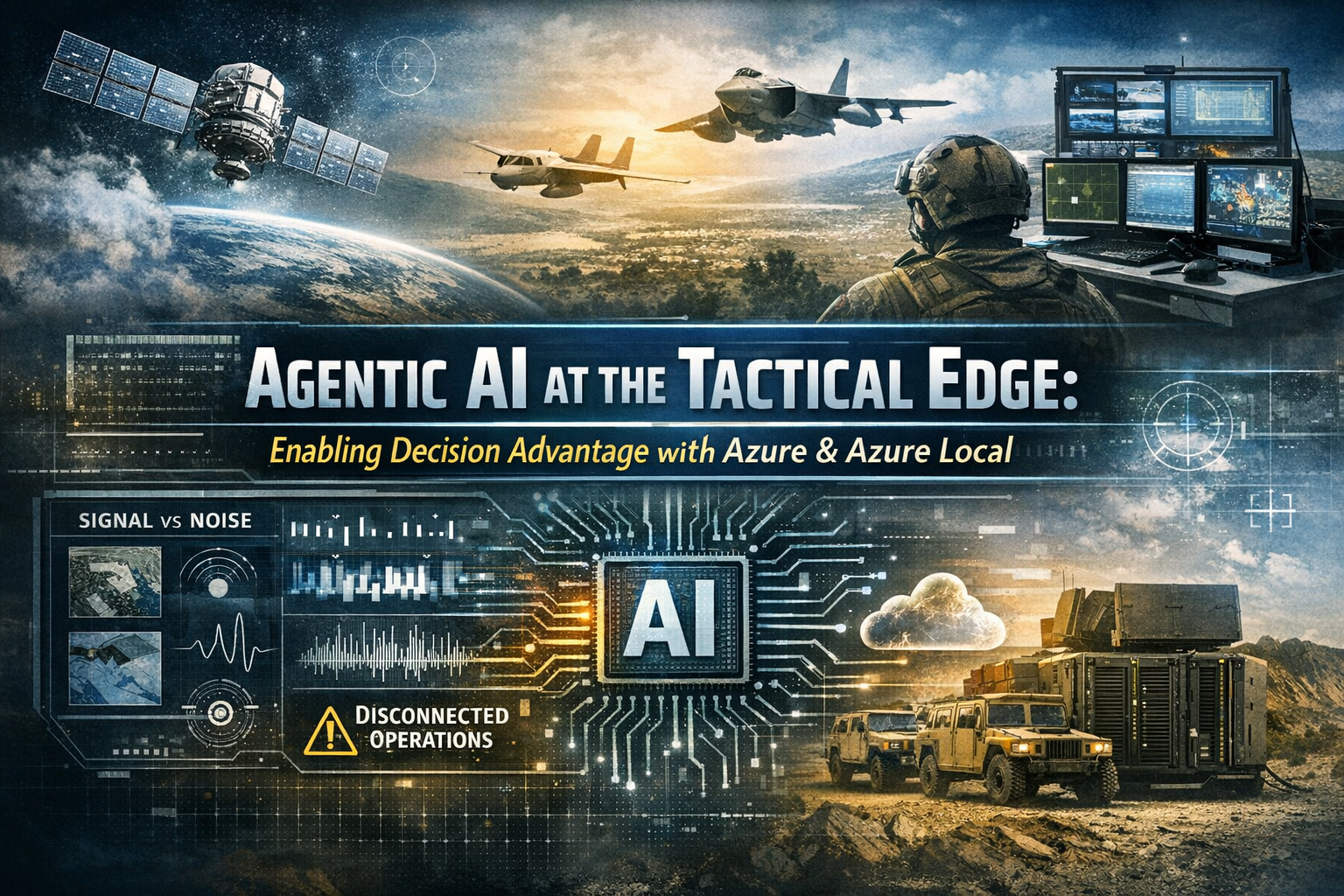
For some time, “AI for the mission” quietly meant “AI in a data center far from the fight.” And honestly that meant that its impact and ability to contribute to mission has been extremely limited.
That assumption is breaking. The Army’s own writing on operationalizing AI at the tactical edge is blunt about why: in a contested, near-peer environment, reach-back to a centralized cloud is a vulnerability, not a convenience. Degraded comms and a contested spectrum mean the intelligence has to live forward — on the platform, in the vehicle, at the disconnected node. The mission question is no longer “can we build the model?” It’s “can we run it where the data actually is?”
Even most recent announcements show Microsoft’s focus on AI at the edge in addition to the cloud. Here’s an interesting announcement from NVIDIA’s own CEO:
That shift is exactly what containers were built for. Packaging an AI workload into a container and orchestrating it with Kubernetes lets the same artifact run in Azure, in Azure Government, on-premises, and at the edge — without a rewrite each time the environment changes. Azure Kubernetes Service (AKS) gives teams a managed path to get there, including a migrate-and-modernize experience that lifts legacy .NET and Java apps off aging VMs and into containers. AKS enabled by Azure Arc then extends that same control plane out to hardware you already own, so inference runs locally — meeting latency, data-residency, and compliance constraints — while still being managed centrally and surviving network outages.
The AI layer has caught up to the mission’s security bar in a way that’s genuinely new. Azure OpenAI is now authorized across every U.S. government classification level up through IL6, frontier models like GPT-4o have been cleared for use inside an isolated, air-gapped Top Secret cloud, and Microsoft has already moved GPT-5.2 into the Secret and Top Secret environments. Just as important, Foundry Local and Microsoft Foundry push that intelligence all the way down to the device: an OpenAI-compatible endpoint, an ONNX runtime, and a ~20MB footprint that runs fully offline with no data leaving the box. There’s even a documented path for staging models across an air gap on removable media — proof that disconnected generative AI is operational reality, not a slide.
None of this sticks without discipline, and that’s where DevSecOps earns its keep. GitOps with Flux v2 on Azure Arc and AKS makes a Git repository the single source of truth: every change is a reviewed, audited commit, and the cluster continuously reconciles itself to the declared state. For accredited and disconnected environments, that audit trail and reproducibility aren’t bureaucratic overhead — they’re the mechanism that lets you ship fast and still pass inspection. The same GitOps workflow that updates an app can update a model artifact at the edge, which is precisely the pattern Microsoft demonstrated for shipping edge AI apps with Foundry.
Put it together and the unique value proposition for Government and DIB customers is hard to match: one container-based development model that runs from commercial cloud to Azure Government to the fully air-gapped edge, an AI stack accredited up to the highest classification levels, on-device inference for the truly disconnected, and a DevSecOps backbone that keeps it all governable. The teams that win the next decade won’t be the ones with the biggest model — they’ll be the ones who can put a trusted model where the mission actually happens, and update it safely from anywhere. That’s the story worth telling.
Industry / Microsoft News
- Lockheed Martin & Microsoft collaborate on next-gen C-UAS (Sanctum) — Azure AI Foundry from HQ to the edge
- Operationalizing AI at the Tactical Edge — U.S. Army (Warrant Officer Career College journal)
- Microsoft’s Azure OpenAI authorized at IL6 for all DoD classification levels — Defense One
- GPT-4o cleared for Top Secret use in Microsoft’s air-gapped Azure cloud — DefenseScoop
- Accelerating AI adoption for the US government — The Official Microsoft Blog
- GPT-5.2 and frontier AI in Azure for U.S. Government Secret & Top Secret clouds — Azure Government Dev Blog
Microsoft’s Value
- Foundry Local — run real AI models fully on-device, offline, no subscription
- Microsoft Foundry Local on a fully disconnected / air-gapped machine (step-by-step)
- Migrate & modernize legacy .NET / Java apps to Windows containers on AKS
Technical Information
- AI inference on AKS enabled by Azure Arc — bringing AI to the edge and on-premises
- Deploy applications using GitOps with Flux v2 on Azure Arc + AKS
- Get started with Foundry Local — OpenAI-compatible, on-device, ONNX runtime
Videos
- From cloud to edge: Building & shipping Edge AI apps with Microsoft Foundry (Ignite 2025, BRK199)
- Azure AI Foundry — full walkthrough playlist (YouTube)