This past week, I’ve been really digging in on the new ANCHOR OTA, and it really is interesting to read and see the implications of this announcement. If you haven’t read it, you can find it here. ANCHOR OTA on SAM.gov
The modern maritime battlespace is undergoing a rapid digital transformation, driven by an urgent need for real-time situational awareness, resilient communications, and AI-powered decision advantage. Naval special operations forces face missions that demand information superiority across contested waters — from ISR collection to clandestine insertions — while adversaries proliferate cheap drones, electronic warfare capabilities, and sophisticated cyber threats. This is an evolving and changing mission space, and one where we are seeing a lot of innovation happen in the past few years.
U.S. Special Operations Command has responded directly: SOCOM Commander Adm. Frank “Mitch” Bradley told lawmakers that AI and autonomous systems are being integrated “at every level” of special operations and are “critical” to sensing the battlefield, maintaining continuous surveillance, and projecting effects when required. The command’s operational demand has surged — Bradley testified to a 300% increase in demands over the past five years — while resources have remained flat, forcing modernization tradeoffs. With SOCOM comprising only 3% of the joint force and less than 2% of the department’s budget, there is increasing pressure to deliver outsized strategic value through technology. These facts are creating an area that is perfect for digital transformation.
A defining element of this shift is bringing cloud computing and AI directly to the tactical edge.
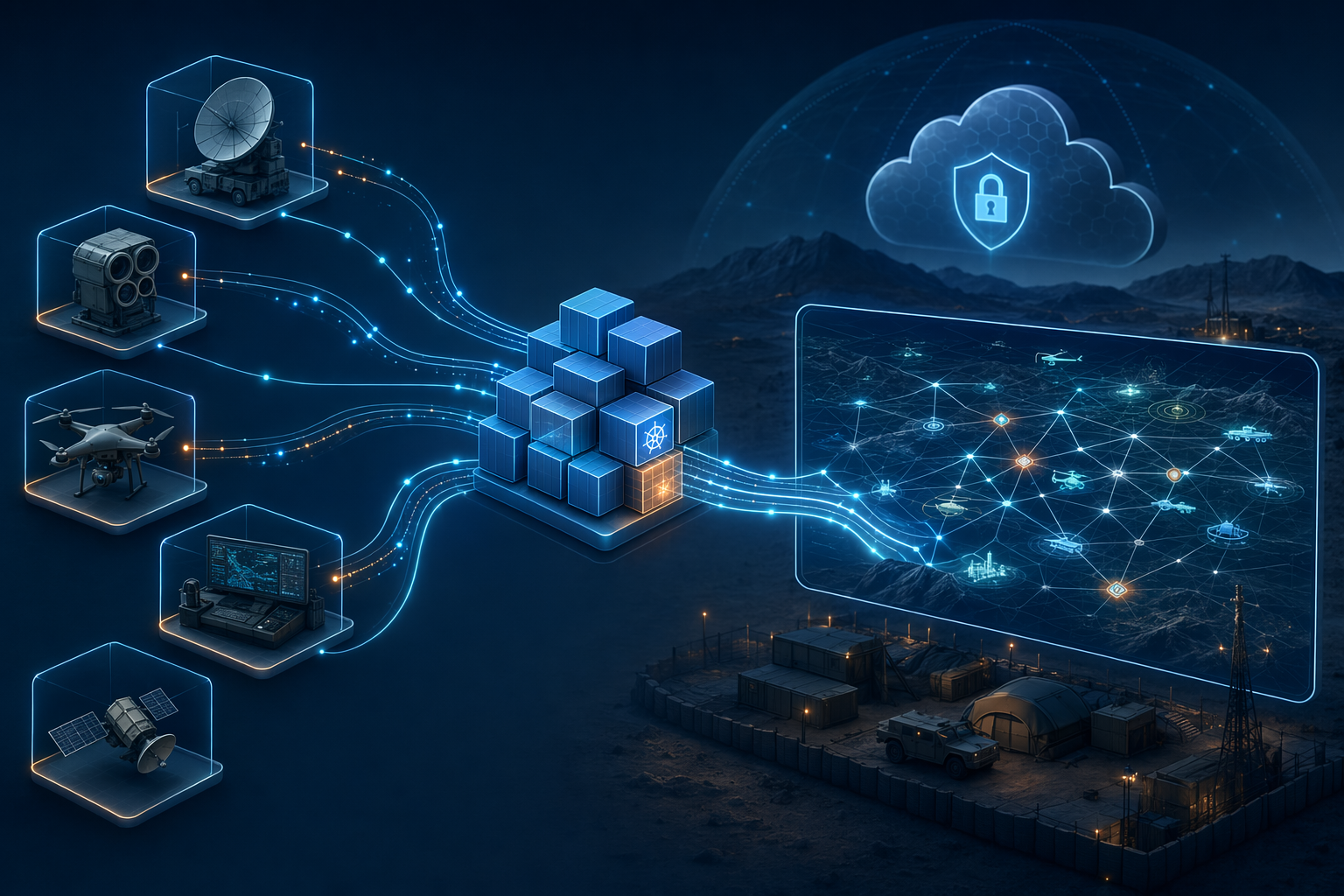
Historically, forward-deployed teams had limited connectivity to centralized systems, creating critical gaps in data processing and decision support. This has been unavoidable given previous technology gaps. But today, solutions like Azure Local on Armada’s Galleon modular datacenters are changing that equation by delivering Azure’s cloud operating model, security, and AI-ready capabilities in environments that are intermittently connected, contested, or fully disconnected.
The technology supports resilient multi-network connectivity — satellite, LTE/5G, RF, and SD-WAN — and can operate sovereign AI workloads with Foundry Local even when offline. This capability maps directly to SOCOM’s ANCHOR initiative, which specifically seeks modernized C5ISR systems that “strengthen edge connectivity, leverage AI-enabled analytics for real-time situational awareness, and ensure data integrity across denied or degraded environments”. The initiative spans six focus areas — unmanned systems, counter-UAS, C5ISR, scalable effects, human performance, and human-machine teaming — with industry responses due June 1.
Artificial intelligence and autonomy represent the most consequential capabilities being fielded. Beyond tactical applications, SOCOM’s Vice Commander Lt. Gen. Frank L. Donovan described how generative AI integrates data from multiple databases to deliver budget insights, helping the command demonstrate taxpayer ROI while enabling staff to “move quicker — with more volume and data”. On the industrial side, the partnership between OSS and USSOCOM to develop rugged High Performance edge Computers (HPeC) for maritime environments aims to enable AI/ML processing aboard ships and platforms, supporting faster decision cycles and cognitive dominance without reliable reach-back connectivity. The ANCHOR notice makes clear that SOCOM envisions unmanned aerial, surface, and underwater platforms providing longer persistence in contested areas, enhanced surveillance, and reduced exposure of personnel to danger. These systems generate massive data volumes, which is precisely why robust edge compute infrastructure is essential.
What is most exciting to me, is Microsoft’s role spans the entire stack — from hyperscale Government cloud regions to tactical edge hardware. Azure Government offers classified environments through IL6 (leveraging Azure Government Secret, the first classified cloud to maintain an IL6 DoD provisional authorization at H-H-x categorization) and Top Secret regions, while Azure Local with disconnected operations uses a virtual appliance to enable deployment and lifecycle management of cloud-native infrastructure in completely air-gapped networks.
Through Azure Arc, disconnected environments gain access to Azure Kubernetes Service, AI containers, and VM management with the same Azure Portal, CLI, and ARM Templates used in connected environments. The partnership with Palantir brings Azure OpenAI Service models into these classified clouds for operational use cases in logistics, planning, and intelligence. Meanwhile, the Azure Modular Datacenter provides enterprise-class compute in a rugged 40-foot container with several thousand cores, petabytes of storage, and support for multiple classification levels — all operable in fully disconnected mode with satellite connectivity options from partners including SpaceX and SES. This continuum from cloud to edge, managed through a consistent operating model, is Microsoft’s core differentiator.
Ultimately, every technology thread points back to one imperative: supporting the operator. Whether it’s an AI model running inference on an Azure edge node aboard a maritime platform, a containerized DevSecOps pipeline deployed in a modular datacenter at a forward location, or a generative AI tool helping headquarters optimize resource allocation, the goal is decision advantage — the ability to outpace adversaries through superior use of information. As the defense community continues deploying these capabilities, the maritime SOF enterprise will be better prepared to operate in denied environments, coordinate across domains, and execute the nation’s most demanding missions. The convergence of cloud, AI, and edge computing in the maritime domain isn’t a future concept — it’s happening now, and both the government and the Defense Industrial Base have a role to play.
Industry / Microsoft News
- SOCOM highlights 6 focus areas for naval capabilities modernization – DefenseScoop (Apr 27, 2026)
- SOCOM adding AI, autonomy “at every level,” commander says – Defense One (Apr 28, 2026)
- OSS partners with USSOCOM to develop High Performance edge Computers for maritime – Nasdaq (May 29, 2025)
- Senior Special Ops leader highlights AI’s usefulness beyond battlefield – DOD News (June 3, 2025)
- Microsoft and Armada bring Azure Local to Galleon modular data centers – DataCenterDynamics (Apr 1, 2026)
- Microsoft, Palantir to supply AI and cloud solutions for US Defense and Intelligence – The Defense Post (Aug 13, 2024)
- Secure edge computing partnership for military and national security – EdgeIR (May 22, 2025)
Microsoft’s Value
- Building sovereign AI at the edge: Azure Local on Galleon modular datacenters – Azure Blog (Mar 31, 2026)
- Azure Modular Datacenter – Mission resiliency for the field – Azure Blog (Dec 7, 2020)
- Microsoft Adaptive Cloud: Advancing edge computing in the defense sector – Microsoft Cloud Blog (Apr 2, 2025)
Technical Information
- Securing AI workloads for autonomous maritime vessels in Microsoft Azure – Just4Cloud
- Cloud infrastructure for disconnected environments enabled by Azure Arc – Microsoft Tech Community (May 19, 2025)
Videos
- Armada deploys modular AI data centers anywhere on Earth – YouTube (2026)
- Naval Engineers Anti-Submarine Warfare Technology: TACMobile Program – DVIDS (Nov 19, 2025)