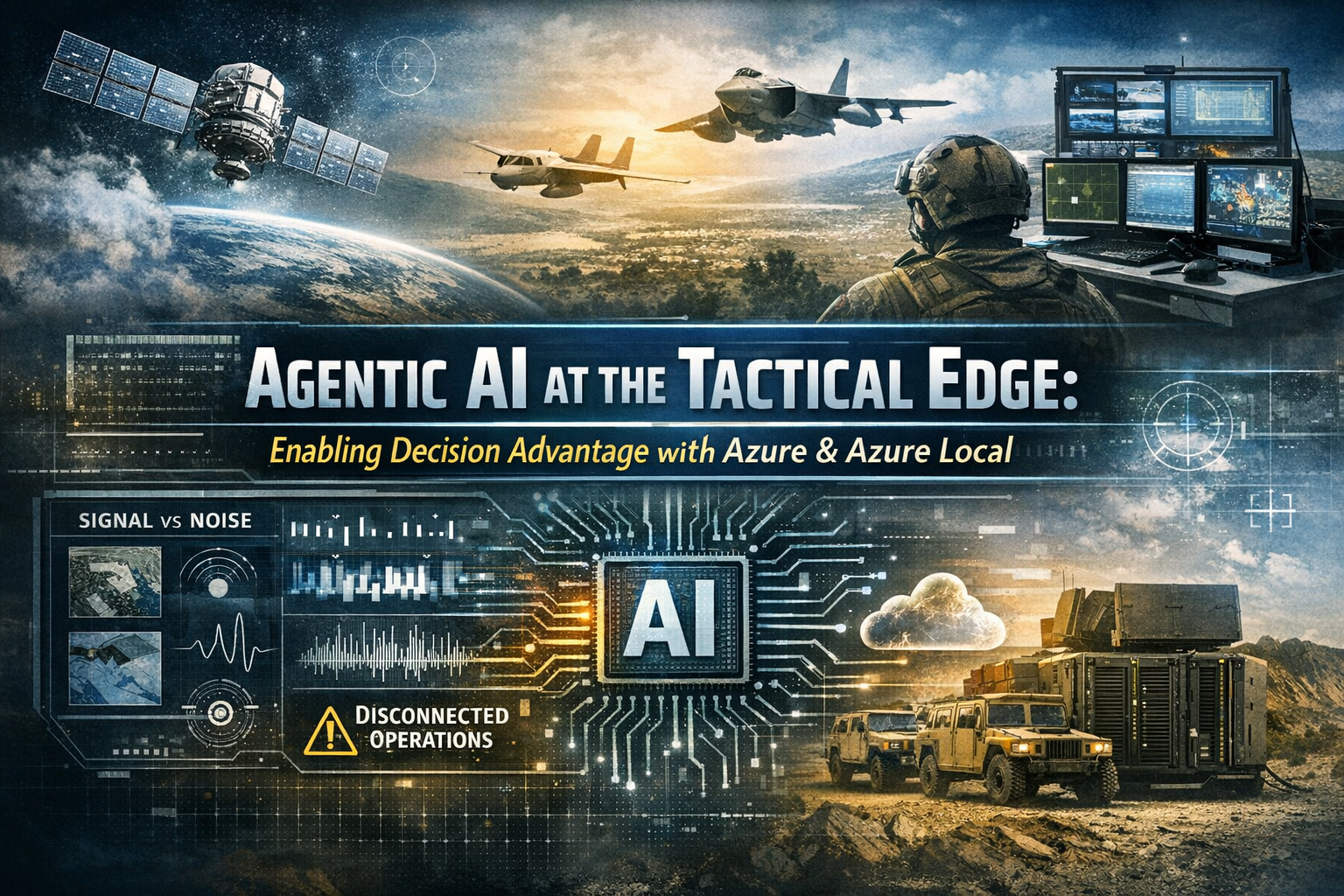
There is absolutely no question, that mission supports needing to deliver at the edge. And it’s a topic I’ve spent a large amount of time on for the past few weeks. There’s been lots of announcements and advancements in this space, and honestly it’s very exciting.
Modern conflict and deterrence are increasingly software-defined, and that shift matters and is becoming more and more important. The mission doesn’t wait for quarterly release trains or multi-year platform refresh cycles — it adapts on contact. That reality is why Department of War modernization guidance continues to emphasize delivery speed with resilience, and why software factories and enterprise cloud programs are being treated as strategic enablers rather than experiments. The simple fact that a defining characteristic of mission execution is speed of innovation.
For government and DIB teams, “build low, deploy high” is less a slogan and more an organizational design problem: standard pipelines, consistent controls, and repeatable environments that can promote software across boundaries. This approach is forcing partners and the Department of War to lean hard into delivery at speed, while maintaining security.
When delivery is treated as a product (platform + pipeline + evidence), teams can move faster without relearning security in every enclave.
The shift from point-in-time authorization to continuous authorization is one of the biggest unlocks for mission delivery. Instead of pausing innovation for paperwork, cATO models focus on continuous monitoring, active defense, and approved reference designs — essentially, building a system where evidence is produced continuously as part of engineering. That aligns security cadence with software cadence.
Cloud adoption in mission environments isn’t one size fits all — it spans hyperscale sovereign controls, classified regions, and fully disconnected/air-gapped operations. What matters most is consistency: using common tooling, common management patterns, and clear compliance guidance so teams don’t sacrifice delivery speed when constraints tighten. Azure Government IL5 guidance and Arc-enabled disconnected approaches are good examples of “practical documentation that engineers can actually execute.”
The DIB’s role is increasingly to deliver capability continuously — not just deliver platforms occasionally. As programs modernize, partners who can prove secure delivery at mission tempo will outpace competitors who treat DevSecOps as a tooling exercise. The near-term opportunity is to standardize the platform, build the evidence pipeline, and make “deploy high” a repeatable motion — even when networks are denied and the environment is air‑gapped.