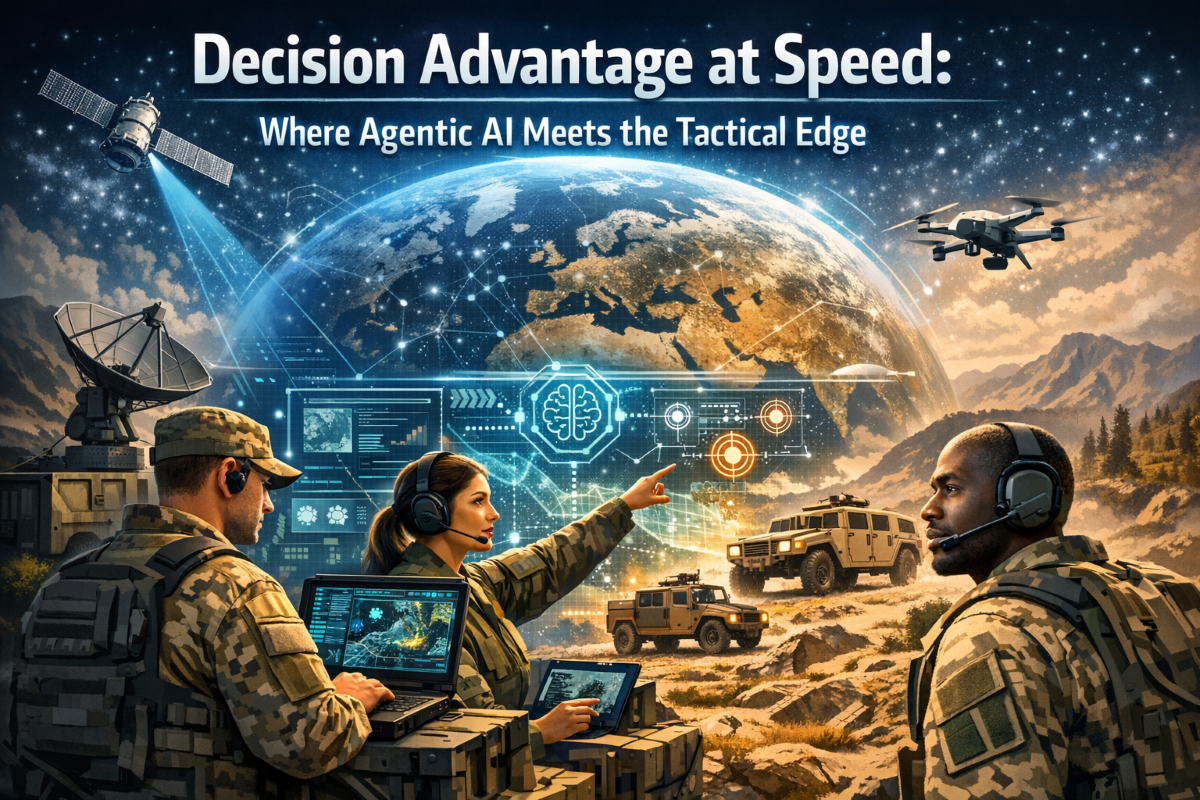
Just had a fantastic week in Nashville at Axon week, and they made a lot of great announcements, including bringing Axon Assistant to the edge via their Body Worn Camera.
Below is a video of the demo:
This is extremely compelling not just for law enforcement, but has implications and similar technologies around the Department of War, focused on the warfighter. Specifically…
Empowering Decision Advantage at the Edge
This concept and need is gaining even more traction with announcements like Foundry Local is now Generally Available | Microsoft Foundry Blog. As a separate announcement. Foundry local is a platform for running LLMs and other AI models at the edge and leveraging Foundry Local Core, and the ONNX binaries for hardware acceleration, which will empower new ways of getting custom AI models, or even LLMs directly to the edge.
The fact is that modern operations are saturated with data: sensors, video, telemetry, signals, logs, and human reporting. The bottleneck isn’t collection—it’s cognition. When humans become the router for every input, tempo slows and uncertainty grows. This makes the process of isolating signal from noise an almost insurmountable challenge.
The opportunity for agentic AI is not “more automation,” but better prioritization: agents that continuously isolate signal from noise and present decision-ready context. And do so in a compliant, secure manner, and under DDIL conditions, or in contested environments.
Agentic AI is most mission-relevant when it behaves like a disciplined staff process: ingest, filter, cross‑reference, summarize, propose options, and maintain traceability. The value isn’t a clever answer—it’s a repeatable loop that compresses sensing → understanding → action while keeping humans in charge. This is why trust, transparency, and control show up as recurring themes in defense discussions of autonomy.
Decision advantage collapses if the architecture assumes perfect connectivity. In contested environments, data is often born at the tactical edge and may never reach a cloud in time (or at all). That forces a practical design principle: run inference where it matters, cache intelligently, and synchronize when possible. Edge-capable patterns—especially edge RAG and edge inference—become the difference between “AI demo” and “mission system.”
Smart and unmanned assets (drones, unmanned vehicles, sensors) introduce a second-order challenge: you’re not just deploying models—you’re operating fleets. That means remote management, configuration drift control, identity, patching, policy enforcement, and continuous monitoring across distributed nodes. It also means security must be architected as a first-class concern because autonomy expands the attack surface and raises the cost of compromise.
For government and DIB customers, the differentiator is the ability to use consistent patterns across regulated environments: hybrid control planes, edge platforms, and security tooling that can carry policy, visibility, and governance into disconnected sites. Azure Arc + Azure Local align to the operational reality of edge, while Azure Government’s AI platform progress is steadily reducing the gap between what teams want to build and what they can actually deploy. And when you add foundry local and look at the technology landscape, things are getting interesting.