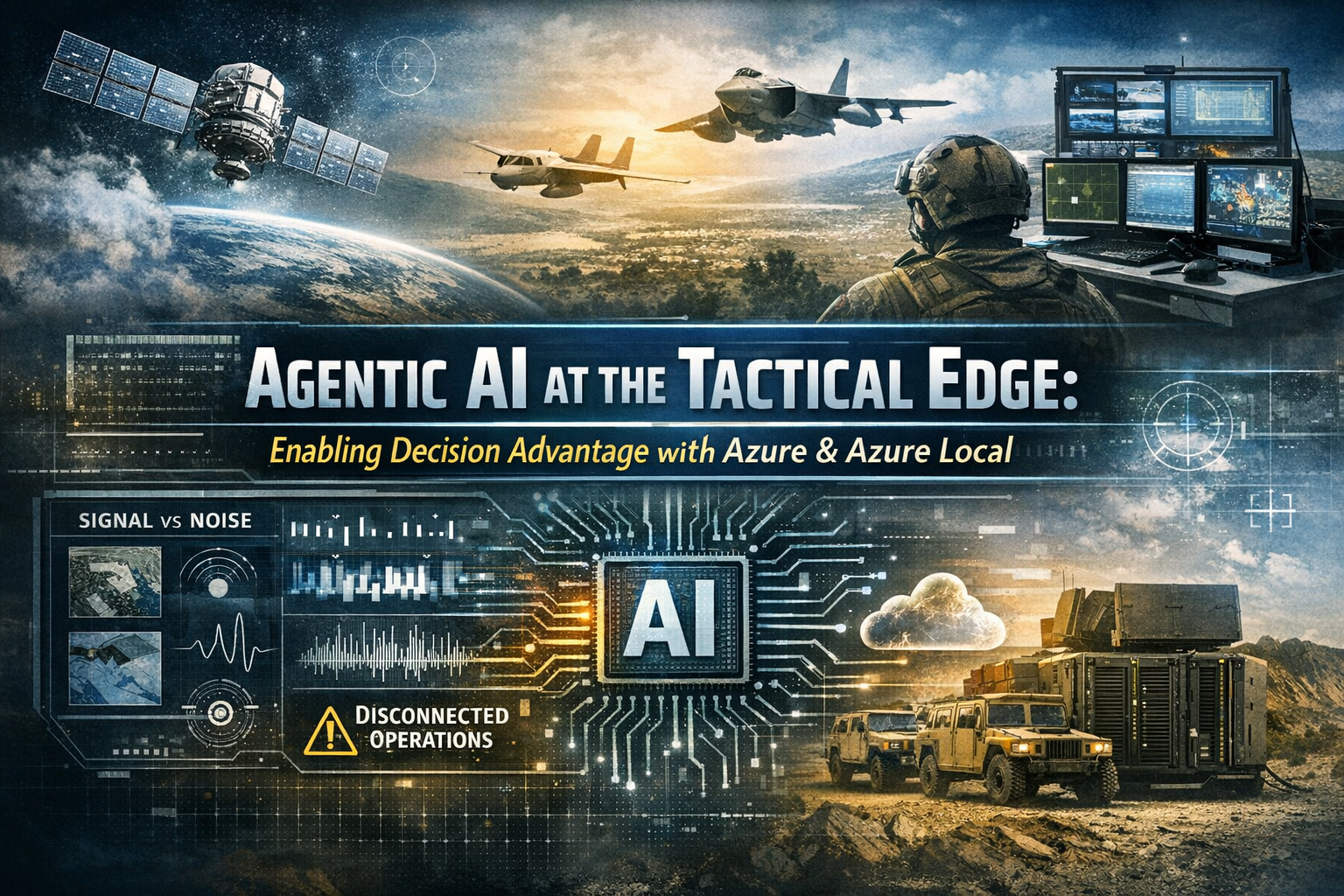
So this week, I got the privilege to attend the AUSA Global Force Symposium, and it was absolutely an eye-opening experience. Seeing the innovative work done by the US Army around defense, and supporting the warfighter, and understanding the concerns and constraints they are required to operate within, and the innovation they have been able to drive is really inspiring.
The reality of modern operations is that sensing outpaces sensemaking. Remote sensing, full-motion video, and signals collection generate immense volume — but operational advantage comes from turning that volume into clarity. Across defense discussions, the emphasis is shifting from “collect more” to “understand faster,” especially in environments where bandwidth is constrained or contested. With further innovations in unmanned solutions, and the evolution of combat tactics, this is becoming more and more important.
This is why “signal vs noise” is becoming the defining design problem. The most valuable processing often needs to happen where data is born: closer to sensors, platforms, and forward nodes. The reality is that in contested environment, communications are targeted, and the ability to leverage the full capabilities in the cloud is not always possible.
Edge AI supports real-time inference, reduces backhaul demands, and enables continued operations when communications are denied or degraded — the practical ingredients of decision advantage. The ability to get the full breadth of capabilities and analytics while connected is important, but maintaining critical capabilities when you are disconnected is absolutely essential.
Agentic application development is the next step beyond isolated models. Instead of a single algorithm producing a score, agentic systems coordinate workflows: ingesting sensor outputs, retrieving mission context, applying policy or rules of engagement constraints, generating options, and routing decisions to humans when escalation thresholds are met. For defense and DIB customers, the most promising direction is multi-modal fusion + orchestration patterns that remain auditable and governable.
Deployment is where mission constraints become real. Government workloads often require strong sovereignty, locality, and operational control — including disconnected or air-gapped scenarios. Recent progress around running cloud-native infrastructure and management patterns in disconnected environments matters because it enables local operations without depending on continuous cloud connectivity, aligning better with mission continuity requirements.
The opportunity for Gov and DIB teams now is to standardize the pattern: build agentic workflows with enterprise-grade orchestration, deploy on edge platforms designed for secure distributed operations, and operationalize governance with baseline architectures that treat security and compliance as first-class design inputs. The result is not “AI for AI’s sake,” but mission systems that can sense, reason, and support human decisions at the speed and locality modern operations demand.
Below is some of the news and links that I’ve found really interesting over the past week.
Industry / Microsoft News
- Industry Using AI to Enhance Space‑Based Communications and Sensing – National Defense Magazine
- How the Military Is Preparing for AI at the Edge – C4ISRNet
- Cloud Infrastructure for Disconnected Environments Enabled by Azure Arc
- Microsoft’s Agentic AI Frameworks: AutoGen and Semantic Kernel
- Azure Local and Microsoft 365 Local Reach GA for Secure Offline Operations
- Worried Europeans Can Now Cut Azure’s Phone Cord Completely – The Register
Microsoft’s Value
- Azure Local Baseline
- Employing Artificial Intelligence and the Edge Continuum for Joint Operations – Atlantic Council
- Harnessing Edge AI to Strengthen National Security – CSIS
Technical Information
Videos
- Disconnected Operations for Azure Local (Short Video)
- Unlocking the Azure Experience at the Edge with Azure Stack HCI (Keynote)